


|
||||||||||||||||||||||||||||||||||||||||||||||||||||||||||||
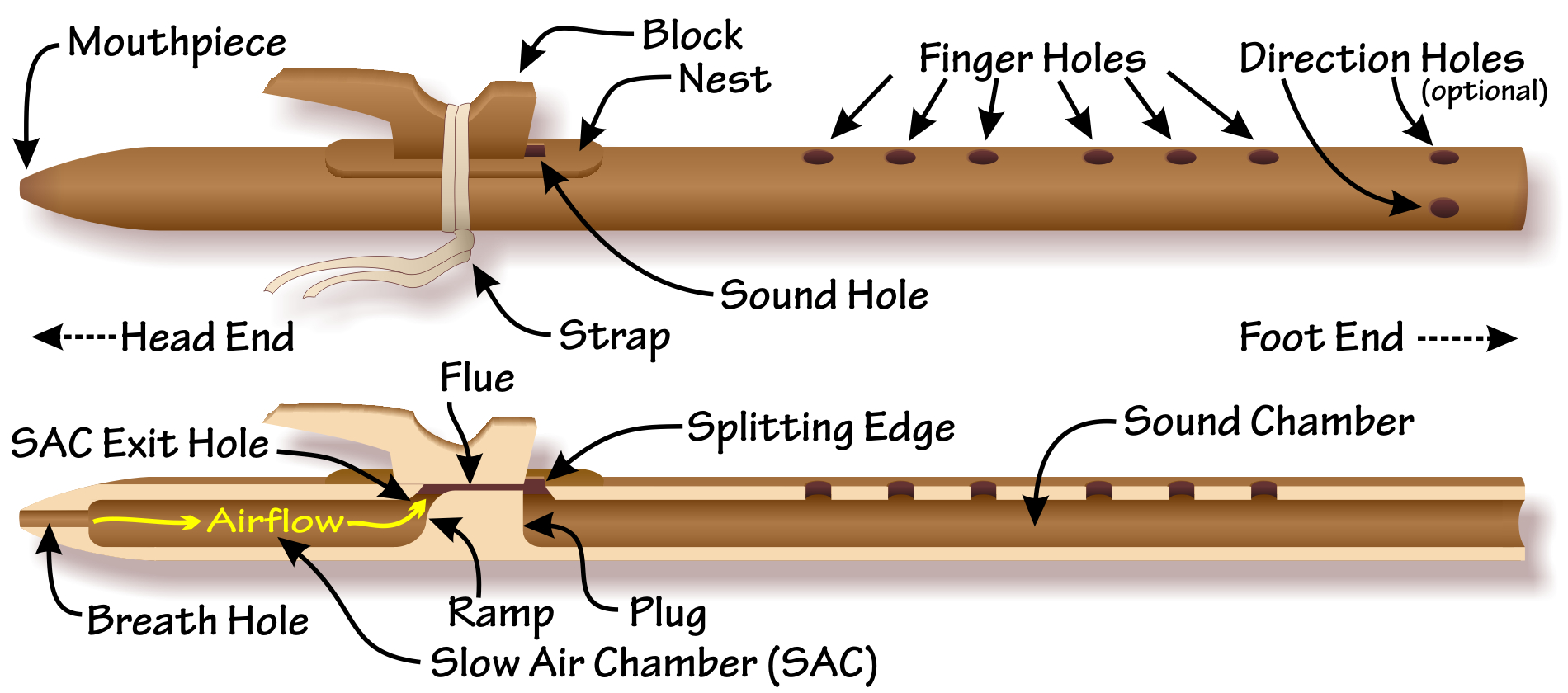
Anatomy of the Native American Flute BasicA Native American flute is: “A front-held, open-holed whistle, with an external block and an internal wall that separates a mouth chamber from a resonating chamber.” Whew! While there are variations in the definition, this version is a direct quote on June 21, 2002 from R. Carlos Nakai, a central figure in the renaissance and resurgence of the Native American flute. The definition helps identify what is and what is not classified as a Native American flute, but to understand it we'll use some diagrams and pictures … Parts of a Native American flute
As simple as the instrument is, there are a lot of things to name, and a lot of ways to name them! The names we use here are the ones you will find on this web site, but we'll also give you many alternate names for each: Mouthpiece. The opening where you breathe into the flute. Also called the “Mouth Pipe” ([Nakai 1996]). Head End. The end of the flute into which you breathe. Also called the “top end”, the “North end”, or the “proximal end”. Block. A separate piece from the body of the flute that is almost always removable. The block plays a critical role in creating the sound of the flute, since it directs air between the two chambers. Also called the “bird”, the “totem”, the “stop piece” ([Fletcher 1911] Nest. The area of the body of the flute where the block rests. Strap. Ties the block onto the nest. Traditionally made of leather. It's a good idea to remove the strap and block on your flute to examine how the flute is constructed. Doing this creates one of the first practical challenges of flute playing, tying the block back onto the flute. Also called the “lashing” or “lacing”. See How to Tie Your Block. Finger Holes. Where you rest your fingers, or lift them off of, when playing. Also called “note holes”, “tone holes” (Dr. Richard W. Payne in [Bee 2006]), and “playing holes”. Also called “stops”, as in “a flute with two stops” meaning “a flute with two finger holes”. The use of the term “stop” is often in archaeological contexts when talking about simple flutes and whistles. Foot End. Also called the “bottom”, the “South end”, or the “distal end”. Design of the BlockThe design of the block can be anything from a simple block of wood to a highly ornate, woodcarving masterpiece. They often take the shape of a bird. The shape of the block is individualized by each maker, and is often an indication of who crafted the flute. Here is an example of an ornate block design on a traditional flute — a historic flute from the collection of Dr. Richard W. Payne. The flute is a juniper flute made by McKinley Standing from the Wichita Indian tradition:
For the outline of the block on the diagrams on this page, I've used a historic flute from the collection of the Bureau of American Ethnology, Smithsonian Institute. The flute from the Cheyenne tradition (BAE information: SI# 165925: Cheyenne; Great Plains; Algonquian; 6 hole; L 20 1/8; D 13/8; 01-1893; from The Bureau of Ethnology (collector - H.R. Voth); metal fipple shield):
Design VariationsThere are many (many) variations on the design shown above. Your flute may look substantially different, but probably has the same basic parts. Here are two significant variations:
Direction Holes. One or more holes nearest the foot end of the flute that are not intended to be covered during normal play. Makers often used four holes to honor the four directions. Also called “tuning holes” because they alter the pitch of the flute when all the finger holes are closed. There are many configurations for direction holes. For example, here is a design that uses slots to serve as direction holes:
The Native American flute is not the only world flute that has direction holes. The khlui from Thailand and Myanmar also had direction holes, in a slightly different configuration. Looking InsideMost of the magic of the instrument happens inside, hidden by the body and the block. Thankfully, I have Corel Draw, so I didn't have to cut a real flute open! This is a view cut straight through the body and the block:
Breath Hole. Where you breathe into the flute. There are many configuration for the breath hole, varying widely in size and shape. Also called the “mouth hole”. Slow Air Chamber (SAC). The first chamber in a Native American flute to receive the player's breath. This chamber provides a place for condensed moisture to collect and also acts as an air bladder to regulate air pressure as it proceeds down the flute. Also called the “mouth chamber”, “compression chamber”, “breath chamber”, “first chamber”, “passive air chamber”, or simply “air chamber”. The slow air chamber acts as a plenum chamber – in this case taking an air source that may be irregular or turbulent and evening out the flow through the exit orifice (the SAC exit hole). It also has the effect of partially silencing sounds coming from the player's respiratory system (for example, humming or throat noises). Plug. Part of the body of the flute that separates the SAC from the sound chamber. This may be constructed of the same material as the body of the flute, or it may be another material such as a cork that is inserted late in the construction process. Also called the “internal wall”. Sound Chamber. The tube that controls the pitch of the sound being played. Native American flutes are designed to create a vibrating wave of air, and the length of the sound chamber determines how fast the air vibrates. Opening and closing the finger holes effectively changes the length of the sound chamber, changing the pitch of the note. Note that the direction holes shown also change the effective length of the sound chamber. Also called the “pipe body”, the “resonating chamber”, or the “variable tube” ([Nakai 1996]). Here is an image of a flute that someone did cut open, showing a Native American flute without the block … This image was provided by Biker Joe
The Sound Hole
The Sound Hole is the most critical part of the flute in terms of creating sound. It is also called the True Sound Hole (TSH). On a Western concert flute, the sound hole serves the same function as the breath hole that the player breathes into. If the sound hole is damaged, the sound of the flute will be substantially affected. Also called the “distal mouth opening” ([Nakai 1996]). Flutes produce two different kinds of tones: edge tones and pipe tones. An edge tone (also called a “pre-whistle”) is generated by the interaction airstream with the splitting edge and is not coupled to pressure waves or sonic vibrations in the sound chamber. An edge tone can be produced and demonstrated by creating a focused airstream across the edge of a piece of paper. Edge tones can be generated on many Native American flutes by breathing extremely softly into the instrument. Edge tones are often produced at the attack of the note, as the airstream first arrives at the splitting edge. These edge tones typically produce frequencies that are much higher than the pipe tone that eventually results. Unline a pipe tone, the frequency of edge tone vibrations are proportional to the velocity of the airstream. Based on the design of the instrument, the edge tone may quickly transition into a pipe tone, which involves an air pressure wave in the sound chamber of the instrument. The creation of a pipe tone is highly dependent on the design of the instrument, particularly the sound hole and sound chamber ([Fuks 2002], [McIntyre 1983]). Under the Block
The cutaway diagram shows the detail of the nest and block area, and how the air flows from the SAC to True Sound Hole. SAC Exit Hole. The path that the air takes out of the SAC and into the Flue. Also called the “Anterior air chamber port” ([Nakai 1996]). Flue. The space formed by the top of the plug and the bottom of the block. This is a very shallow (but often wide) channel that routes air to the sound hole. The shape of the flue is very important to the creation of the flute's sound. Also called the “channel” or “windway”. The flue is a primary place where condensed moisture collects. When this happens the shape of the flue is changed, which has a dramatic effect on the sound of the flute, even to the point of silencing the instrument. Ramp. The part of the plug that directs airflow out of the SAC and into the flue. The shape of the ramp affects how turbulent the air is in the flue, and has a substantial effect on the flute's sound. Splitting Edge. Your breath travel through the slow air chamber, down the flue, and across the true sound hole, and then hits the relatively sharp splitting edge. The job of the splitting edge is to set the air vibrating … alternating between going above and below the splitting edge. This is similar to what happens when a flag flutters in a stiff breeze. The splitting edge is all called the “cutting edge”, the “fipple”, the “fipple edge”, the “languid lip” (Ken Light), and the “sound edge” (Dr. Richard W. Payne in [Bee 2006]). Here's an image, courtesy of Don from Spokane, WA.
Transition from the Flue to the Sound Hole
The two edges of the flue at the point where the air stream exits the flue into the sound hole. The upper lip is typically part of the block and the lower lip is part of the body of the flute. Note that I (Clint Goss) proposed this use of the terms upper lip and lower lip on November 7, 2016. I was working with a flute maker and needed a term to describe these two edges. The terms were proposed to a group of flute makers on Facebook, and a majority of flute makers agreed that these were appropriate terms (although agreement was not unanimous). A more descriptive phrase for “lower lip” might be “the South end (or distal end) of the flue floor” (suggested by Keith Stanford) or the “shelf at the back wall of the bore” (suggested by Tom Cramer). Another phrase to describe the “upper lip” is the “totem heel” (suggested by Tom Cramer, using the term “totem” for “block”). Organ PipesNote that the makers of organ pipes use the terms “lower lip” and “upper lip” for completely different components of their instruments. The rationale for these differences lie in part with the orientation of flue pipes in a pipe organ: they are vertical, with the air entering the instrument from the bottom.
Vibrations at the Sound HoleThese moving images show an air pressure wave at the sound hole of a flute. They are from
Luchtwervels in een blokfluit «Air Vortices in a Recorder»
([Hirschberg 1999] The images are reversed from other images on this page — the flue is at the right and the airstream is moving from right to left. They show how the air coming out of the flue crosses the sound hole and hits the splitting edge:
The left image shows the behavior of the airstream coming out of the flue at the onset of a tone — what would be the attack or edge tone at the start of a note. The air initially flows up and away without any vibration or oscillating pattern. The right image shows what happens a bit later, after an oscillation has been established. This osciallation happens because of the specific shape of all the aspects of the flute, but in particular the shape of the flue, the sound hole, the splitting edge, and the flute's sound chamber. The caption in [Hirschberg 1999] Oscillations of the air jet in the mouth of a recorder with a fundamental frequency of 513 Hz. The core gap is 1 mm, the distance between the core and the output gap of the labium is 4 mm. The visualization is obtained using the so-called Schlieren technique: the whistle blows CO2 and creates a contrast in the refractive index. Presumably, the “core” referred to is the height of the flue. Spacer Plates
Spacer Plate. This is a common variation in the design of the nest area. A plate, often made of brass, sits between the block and the nest. In this design, the splitting edge is often part of the spacer plate, rather than part of the body of the flute, and the flue is formed by a slot in the spacer plate:
Here's a picture of a flute by Dr. Richard W. Payne which uses a spacer plate:
Fipple ShieldsSome flutes, especially flutes crafted in the tradition of the Kiowa and Cheyenne cultures, use a fipple shield as part of the design of the nest area. The fipple shield is typically a thin plate, often made of metal, fixed to the body of the flute just past the block. It forms the splitting edge of the sound mechanism:
Note that the fipple shield is typically tied onto the body of the flute, similar to the strap that holds the block onto the flute, but that is not shown in the diagram above. Also, no wings are shown on the sides of the block — if they were present, the proximal edge of the fipple shield would typically line up with the distal end of the wings on the block. Also called a “lip plate” ([Hensley 2002]). Jon Norris provided information on the prevalence of fipple shields on older flutes (personal communication, August 11, 2016): I’d say fipple shields are fairly common in old flutes. I would guess it was used on maybe 20 to 30 percent of the old flutes I’ve seen. Belo Cozad (Kiowa) used them on all of his flutes, and I’ve seen them on other Kiowa flutes as well. Grover Wolf Voice and John Turkey Legs (both Northern Cheyenne), Ira Cut Hair (Ute), and many other makers did as well. Here is a historic flute with a fipple shield from the collection of the Bureau of American Ethnology, Smithsonian Institute. The flute from the Cheyenne tradition (BAE information: SI# 165925: Cheyenne; Great Plains; Algonquian; 6 hole; L 20 1/8; D 13/8; 01-1893; from The Bureau of Ethnology (collector - H.R. Voth); metal fipple shield):
Shape of the Block
The shape of the block near the sound hole is very important to the sound of the flute. Some flutes, such as the one pictured above on the left, have a chimney that borders three sides of the sound hole. The sides, or wings, give some protection if you are trying to play in a breeze. Other flutes, such as the one pictured on the right, have a flat face. The two photographs above are actually from the same flute – a D minor Native American flute by Edward Kort. The block of this flute is reversible: one face has a chimney and the other has a flat face. Composite Anatomy Diagrams in Many LanguagesThis section provides anatomy diagrams that are a composite of the outside and inside of a Native American flute. Labels are provided in 11 languages. These images are released on Wikipedia under a Creative Commons Attribution-Share Alike 3.0 Unported license. Each of the 760 × 336 pixel images below is linked to a higher-resolution image at 1900 × 840 pixels. Click on the image to access the larger version: Cherokee
Dutch
English
Esperanto
French
German
Japanese
Korean
Polish
Russian
Spanish
| ||||||||||||||||||||||||||||||||||||||||||||||||||||||||||||




|
To cite this page on Wikipedia: <ref name="Goss_2026_anatomy"> {{cite web |last=Goss |first=Clint |title=Anatomy of the Native American Flute |url=http://www.Flutopedia.com/anatomy.htm |date=30 March 2026 |website=Flutopedia |access-date=<YOUR RETRIEVAL DATE> }}</ref> |